No.1 Ceiling Laminar Airflow Manufacturers in Chennai | +91 9551599977
Find Ceiling Laminar Airflow Manufacturers Chennai at Sterile Tech India ✓No.20, Bangalore High Way Road, Near Nazarathpettai Bus Stop, Chennai – 600 123.

Sterile Tech TM India offers ceiling laminar airflow systems designed to provide HEPA-filtered air for selected controlled environments. These ceiling-mounted systems are used in operation theatres, pharmaceutical filling and packing areas, and other applications where controlled airflow and airborne particle management are important.
Ceiling laminar airflow equipment is installed above the designated work area to supply filtered air in a controlled downward direction. Depending on the system design, the equipment can include HEPA filters, pre-filters, blower assemblies, differential pressure gauges, and optional side screens.
As a cleanroom equipment manufacturer and supplier in Chennai, Sterile Tech TM India provides ceiling laminar airflow solutions for facilities that require application-specific airflow arrangements and cleanroom equipment.
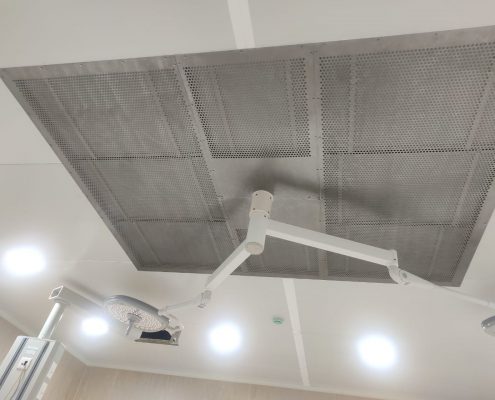
Ceiling Suspended Laminar Air Flow (CLAF) is used for Operation Theatre applications, Pharma filling & packing line etc. CLAF provides ultra clean sterile HEPA filtered CLASS 100 air in a remote area where the exceedingly responsive progression activities are carried-out. CLAF equipped with Minipleat HEPA with dynamically balanced ultra-low noise blowers for optimum airflow. Differential pressure monitoring carried through MAGNEHELIC Gauges. Fabricate by customized range of CLAF equipment and solution to our clients.
The cabinet will be hung from the ceiling using SS chain. Access for servicing the pre filters, blowers or replacing HEPA filters will be provided from the bottom side of the unit. Side screens, made of clear flexible PVC curtain are provided for a height of about 600 mm from the HEPA filter level.
Ceiling laminar airflow, also known as ceiling-suspended laminar airflow (CLAF), is an airflow system installed above a designated working or treatment area. It directs filtered air downwards to help control airborne particles around the target zone.
The system is commonly considered for operating theatres, pharmaceutical production lines, and selected controlled environments. Proper design, installation, airflow balancing, and performance testing are important to achieve the required operating conditions.
Ceiling laminar airflow systems can be incorporated into suitable operation theatre designs to provide filtered downward airflow over a designated surgical area. System selection should consider the theatre layout, HVAC design, lighting, medical equipment, and applicable healthcare requirements.
Ceiling-mounted systems may be used over selected filling, packing, and product-handling areas where controlled airflow is required. The equipment should be selected according to the product, process risk, room classification, and applicable pharmaceutical requirements.
Ceiling laminar airflow can support controlled working zones in suitable cleanroom environments. Integration with the room’s air-handling system and other contamination-control measures is essential.
Certain precision assembly, inspection, and material-handling processes may benefit from ceiling-mounted filtered airflow. The design must be matched to the process and the level of cleanliness required.
| Parameter | Published specification |
|---|---|
| Cleanliness classification | Class 100 as per US FED-STD-209E |
| Air velocity | 90 FPM ± 20 FPM |
| Maximum noise level | 65 dB |
| Power supply | 230 V, single phase, 50 Hz |
| Particle size reference | 0.3 micron |
| Supply filter | Mini-pleat HEPA, stated as 99.99% at 0.3 µm, H14 |
| Pre-filter | Micro glass fibre media, EU-4 rating |
| Blower assembly | Statically and dynamically balanced centrifugal blower |
| Installation | Ceiling-suspended configuration |
Technical note: The listed specifications are published product details, not a guarantee of performance under every installation condition. Confirm filter test certificates, airflow measurement methods, acoustic conditions, and required cleanroom classification. Class 100 under FED-STD-209E should not automatically be treated as proof of ISO Class 5 compliance without appropriate testing and documentation.
Actual performance depends on system configuration, room airflow, installation quality, operating conditions, and maintenance.
Before choosing a ceiling laminar airflow system, consider the following:
| Sterile Tech TM Model Number | SCL 42 | SCL 43 | SCL 44 | SCL 63 | SCL 64 | SCL 84 | SCL 86 |
| Working Size (LxW) Ft | 4’x2′ | 4’x3’ | 4’x4’ | 6’x3’ | 6’x4’ | 8’x4’ | 8’ × 6’ |
| Sterile Tech TM Model Number |
Working Size (LxW) Ft |
| SCL 42 | 4’x2′ |
| SCL 43 | 4’x3’ |
| SCL 44 | 4’x4’ |
| SCL 63 | 6’x3’ |
| SCL 64 | 6’x4’ |
| SCL 84 | 8’x4’ |
| SCL 86 | 8’ × 6’ |

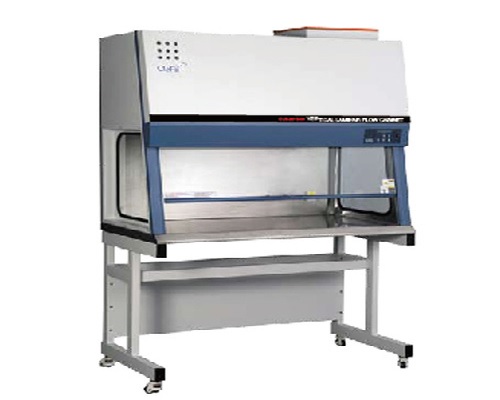

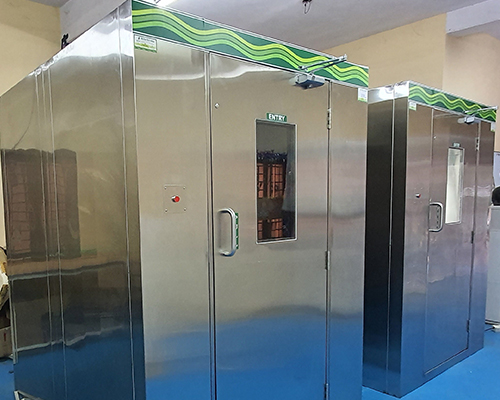


Sterile Tech TM India offers ceiling laminar airflow equipment as part of its cleanroom and laminar airflow product range. Its published product information includes ceiling-suspended systems for operation theatre and pharmaceutical filling and packing applications.
Customers can discuss their project requirements, installation dimensions, airflow coverage, filter specifications, and intended application with the team.
Before finalising your order, request the approved technical datasheet, drawings, material details, filter documentation, installation scope, and testing requirements for the selected system.
It is a ceiling-mounted system that supplies filtered air downwards over a designated area to help control airborne particles.
They may be used in operation theatres, pharmaceutical filling and packing areas, cleanrooms, and selected industrial production environments.
HEPA filters are commonly used, with pre-filtration selected according to the system design. Confirm the filter grade and performance documentation for the specific model.
Dimensions and installation arrangements can be discussed according to the project layout and required coverage. Confirm the available options with the supplier.
Replacement depends on filter condition, pressure drop, operating hours, environmental conditions, and the manufacturer’s maintenance guidance. Use inspection and performance data rather than relying only on a fixed interval.


